

If your tooth hurts when you drink something cold, the first person to see is a general dentist. In Old Bridge, NJ, you can book an exam with Bond Dental Studios. A dentist will examine the tooth, work out what is causing the sensitivity and refer you to a specialist only if one is needed. If the pain lingers, throbs, wakes you at night or comes with swelling, call promptly rather than waiting.
Tooth hurts when I drink something cold: who should I see in Old Bridge, NJ?
The short answer: start with a general dentist
A general dentist examines, diagnoses and treats the most common causes of cold sensitivity. These range from worn enamel and receding gums to cavities and old fillings. You do not usually need a referral to book a general dental exam.
Why a dentist, not a specialist, is usually the first stop
Cold sensitivity has several possible causes, and many of them feel alike from the patient’s side. A sharp twinge from a small cavity can feel much like a twinge from an exposed root.
Specialists such as endodontists and periodontists focus on specific problems. A general dentist can look at the whole picture first and decide whether you need one. That saves you from guessing which specialist to call.
Seeing a dentist in Old Bridge, NJ: Bond Dental Studios
Bond Dental Studios is a dental practice in Old Bridge, NJ. If you are looking for a dentist in Old Bridge because a tooth reacts to cold drinks, we can examine the tooth, explain what we find and talk you through your options.
Why cold drinks can make a tooth hurt
What exposed dentin means, in plain language
Each tooth has a hard outer layer. That layer is enamel on the crown and cementum on the root. Underneath sits dentin, a softer layer with tiny channels that lead toward the nerve.
When the outer layer wears away or the gum pulls back, dentin can be exposed. Cold reaches the nerve more easily through it, and you feel a sharp, short pain. Many of the causes below come back to this idea.
Enamel wear and acidic food and drink
Enamel can wear down over time. Common contributors include frequent acidic drinks such as soda, sports drinks, citrus juices and wine, as well as acid reflux, clenching or grinding, and brushing too hard.
Gum recession and exposed roots
When gums recede, part of the root can be exposed. Roots are not covered by enamel, so they are often more sensitive to cold. Recession can be linked to gum disease, aggressive brushing or other factors that a dentist can assess.
A cavity or a worn or leaking filling
Tooth decay can break through enamel and expose dentin. An older filling can also wear, chip or develop a gap at its edge. Either problem can let cold reach the inner tooth.
A cracked tooth
A crack is not always visible. Sometimes the only signs are sensitivity to cold or a sharp pain when you bite down and release. Cracks are worth having checked early because they may get worse over time.
Temporary sensitivity after dental work or whitening
Some people notice sensitivity for a while after a new filling, a cleaning or tooth whitening. This often settles, but tell your dentist if it is severe, gets worse or does not improve.
Mild twinge or warning sign? When to book promptly
Not all cold sensitivity means the same thing. The table below is a general guide only. It is not a diagnosis, and any persistent sensitivity is worth having checked.
| What you notice | What it may point to | Suggested next step |
|---|---|---|
| A brief twinge that fades as soon as the cold is gone | Often exposed dentin, worn enamel or receding gums | Book a routine exam and try gentle interim steps |
| Pain that lingers after the cold is gone | Possible irritation or inflammation of the nerve | Book promptly |
| Spontaneous, throbbing or night-time pain | Possible nerve involvement or infection | Call the dentist promptly |
| Pain when biting, or a visible crack or chip | Possible cracked tooth or broken filling | Call the dentist promptly and avoid chewing on that side |
| Swelling in the gum or face, or fever | Possible infection | Seek urgent care; see the guidance below |
Brief sensitivity that fades quickly
A short, sharp twinge that stops quickly is the most common pattern. It is usually not an emergency, but it is still worth a dental check so the cause can be found.
Pain that lingers after the cold is gone
If the ache hangs on after you have finished your drink, the nerve inside the tooth may be irritated. Do not wait for your next routine check-up.
Spontaneous, throbbing or night-time pain
Pain that starts without a trigger, throbs or wakes you up is a warning sign. Call a dentist promptly.
Pain when biting or a visible crack
Pain on chewing, or a crack or chip you can see or feel, should be looked at soon. Until then, chew on the other side.
Swelling or fever: when to seek urgent or emergency care
Swelling of the gum, face or jaw, or a fever alongside tooth pain, can be a sign of infection. Contact a dentist urgently. If swelling is spreading, or you have difficulty breathing or swallowing, go to an emergency room or call 911.
Dentist, endodontist or periodontist: who does what
The general dentist’s role: exam, diagnosis and treatment
Your general dentist is usually the right first stop. They examine the tooth, find the likely cause and handle many treatments directly, such as fillings, bonding and advice on sensitivity.
When a referral to an endodontist may make sense
Endodontists specialize in the inside of the tooth: the nerve and the root canals. A general dentist may refer you to one if the nerve appears inflamed or infected, or if a root canal case is complex.
When a referral to a periodontist may make sense
Periodontists specialize in the gums and supporting bone. A referral may make sense if gum recession or gum disease is significant and needs specialist treatment.
Why the cause should be confirmed by an exam, not self-diagnosed
Symptoms overlap, so it is hard to tell a crack from a cavity or recession at home. An exam, and X-rays where appropriate, lets a dentist confirm the cause before deciding on treatment or a referral.
What to expect at your visit
Questions about your triggers and symptoms
Expect questions about which tooth hurts, what sets it off and how long the pain lasts. You may also be asked about recent dental work, whitening, grinding, reflux and your diet.
The exam and possible X-rays
The dentist will look at the teeth and gums and may gently test the tooth with cold, air or light pressure. X-rays may be taken if they are needed to check for decay, problems around a filling or issues near the root.
Treatment options that depend on the cause
Options depend entirely on what the exam finds. They may include:
- Desensitizing treatments or a recommended toothpaste
- A filling to repair decay or replace a worn filling
- Bonding to cover exposed dentin or a worn area
- A crown to protect a cracked tooth
- Root canal treatment if the nerve is affected
- Gum treatment, or a referral, if recession or gum disease is involved
In some cases, a tooth that cannot be saved may need an extraction. Your dentist will explain the options, the trade-offs and what is realistic for your tooth. No treatment can be guaranteed to work in every case.
Where tooth-colored fillings and dental bonding may fit in
Tooth-colored fillings repair decay or replace old fillings while matching the shade of your teeth. Dental bonding uses a similar material to cover exposed or worn areas. Both are common options when sensitivity comes from a cavity, a worn filling or a small area of exposed dentin. Whether either one suits you depends on the exam.
What you can do until you are seen
These are general, low-risk steps. They can help with comfort, but they do not replace a dental exam.
Desensitizing toothpaste
Over-the-counter toothpastes for sensitive teeth are designed to reduce sensitivity with regular use. They may take some time to help. Follow the directions on the pack.
Switching to a soft-bristled brush
Use a soft-bristled brush with gentle, small movements. Hard scrubbing can wear enamel and irritate gums.
Limiting very cold or acidic drinks for now
Cut back on iced drinks and acidic drinks until you are seen. If you do have them, using a straw and rinsing with water afterward may help.
What to avoid doing at home
- Do not place aspirin or other tablets directly on the gum or tooth.
- Do not try to file, glue or fix a cracked tooth or a broken filling yourself.
- Do not use whitening products while the tooth is sensitive.
- Do not let a desensitizing toothpaste hide a problem that keeps coming back.
Action checklist: cold-sensitive tooth
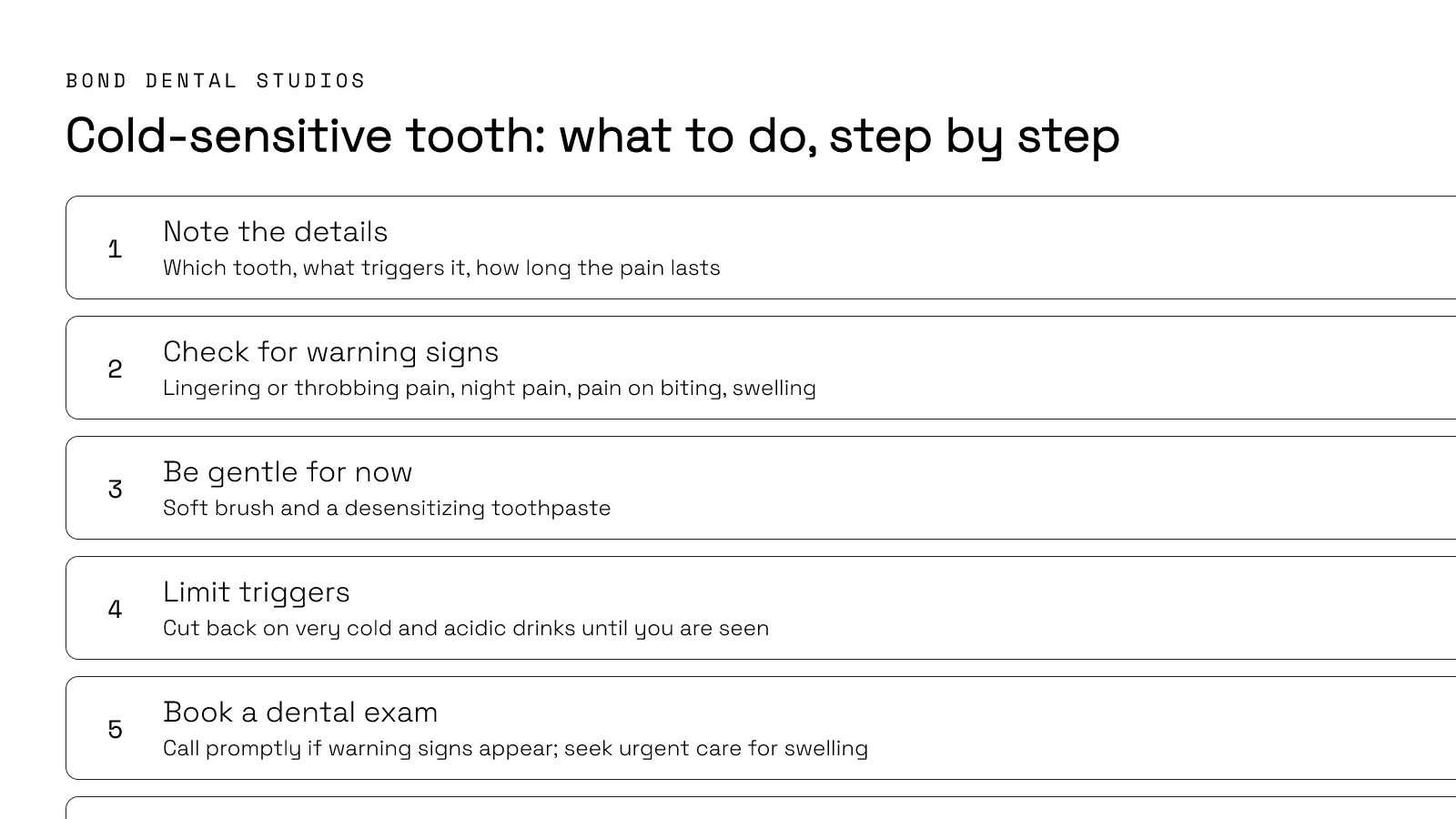
- Note which tooth hurts, what triggers it and how long the pain lasts.
- Check for warning signs: lingering pain, throbbing, night pain, pain on biting, a crack or swelling.
- Switch to gentle brushing with a soft brush and a desensitizing toothpaste.
- Avoid very cold and acidic drinks until your appointment.
- Book a dental exam, and call promptly if any warning signs appear.
- Bring a list of recent dental work, whitening and any medications you take.
Bond Dental Studios in Old Bridge, NJ
Where to find us and how to book
Bond Dental Studios is in Old Bridge, NJ. To book an exam for a sensitive tooth, contact the practice by phone or through our website.
Emergency or same-day appointments in Old Bridge
If you think your tooth needs urgent attention, call and describe your symptoms. The team can tell you how soon you can be seen and what to do in the meantime.
Treatments for sensitive teeth
Depending on the cause, care for a cold-sensitive tooth may involve desensitizing treatment, tooth-colored fillings, dental bonding or other restorative work. Ask us which options are suitable for your tooth after your exam.
FAQ: cold-sensitive teeth
Is cold sensitivity an emergency?
Usually not. A brief twinge that fades quickly is common and can be checked at a routine visit. Pain that lingers, throbs, wakes you at night or comes with swelling or fever needs prompt or urgent care.
Should I see a dentist or an endodontist first?
Start with a general dentist. They can find the cause and treat many problems directly. If the nerve or root needs specialist care, they can refer you to an endodontist.
Can a sensitive tooth go away on its own?
Sometimes. Sensitivity after whitening or new dental work often settles. Sensitivity from a cavity, a crack or a leaking filling usually does not resolve without treatment, so it is worth having it checked.
Where can I get a tooth-colored filling in Old Bridge, NJ?
A general dentist in Old Bridge, NJ, such as Bond Dental Studios, can examine the tooth and tell you whether a tooth-colored filling or dental bonding is a suitable option.
When should I look for an emergency dentist in Old Bridge, NJ?
Look for urgent dental care if you have severe or throbbing pain, pain that keeps you awake, a broken tooth or swelling. If swelling is spreading or you have trouble breathing or swallowing, go to an emergency room.
Get your sensitive tooth checked
A tooth that hurts with cold drinks is your mouth telling you something has changed. A quick exam can find out what it is. If you are in or near Old Bridge, NJ, and a tooth is bothering you, get in touch with Bond Dental Studios and we will be glad to take a look.